Indiana 2026: When Politicians Replaced Fire Safety Experts
Safer Buildings Coalition | April 2026
In March of 2026, the Indiana General Assembly passed two bills that will make Indiana’s buildings less safe for the people who live and work in them — and for the firefighters who respond when something goes wrong.
Here is what happened, why it matters, and what the fire safety community can do about it.
What the Indiana Legislature Did
Two bills were signed into law in March 2026.
House Bill 1003 abolished the Fire Prevention and Building Safety Commission — the independent, bipartisan body that has governed Indiana’s building and fire safety codes for nearly 40 years. That body is gone as of July 1, 2027. Its authority transfers to the Indiana Department of Homeland Security. Every nationally recognized safety standard currently adopted in Indiana — including those governing fire alarms, electrical systems, and emergency responder communications — is now frozen at editions that are more than a decade old. Any update requires a vote of the state legislature.
House Bill 1003 was framed as government efficiency legislation. It abolished or restructured more than 60 state bodies in a single bill. Of all of these bodies, the Fire Prevention and Building Safety Commission was the only one that generated a formal legislative defense — two bipartisan amendments seeking to preserve the Commission. Both were defeated. The vote record shows that concern existed in the Indiana legislature. It was not enough.
House Bill 1001 prohibits any government body in Indiana from requiring the installation of emergency responder communication enhancement systems (ERCES) in Class 1 structures — broadly defined as any building used by the public, with three or more tenants, or with more than one employee. It also bans arc-fault circuit interrupter (AFCI) requirements in covered residential occupancies. Existing local ordinances are voided. No community may opt out. Any new ordinance requiring these systems is unlawful.
Both prohibitions take effect July 1, 2026.
|
What is an ERCES? Emergency Responder Communication Enhancement Systems are in-building radio signal systems that ensure firefighters and other first responders can communicate by radio inside structures where building materials would otherwise block or degrade their signals. When a first responder inside a building cannot reach their command, or their command cannot reach them, lives are at risk — both the responder’s and the people they are trying to save. |
|
What is an AFCI? Arc-Fault Circuit Interrupters are electrical safety devices that detect dangerous arcing conditions in wiring — a leading cause of residential electrical fires. When arcing is detected, the device interrupts the circuit before a fire can ignite. 48 states require them. Indiana has now made it illegal for any level of government to require them in the covered occupancy classes. |
|
What is a code adoption body? Building and fire safety codes are developed by independent technical organizations — groups of engineers, fire scientists, code officials, and safety professionals who study fire behavior, test materials, and incorporate lessons from real-world incidents. State and local governments adopt these codes, typically by reference, updating them as new editions are published. Indiana’s Fire Prevention and Building Safety Commission was the body that managed this process for nearly 40 years. It is now abolished. Future updates require the state legislature to act. |
Who Advanced These Bills
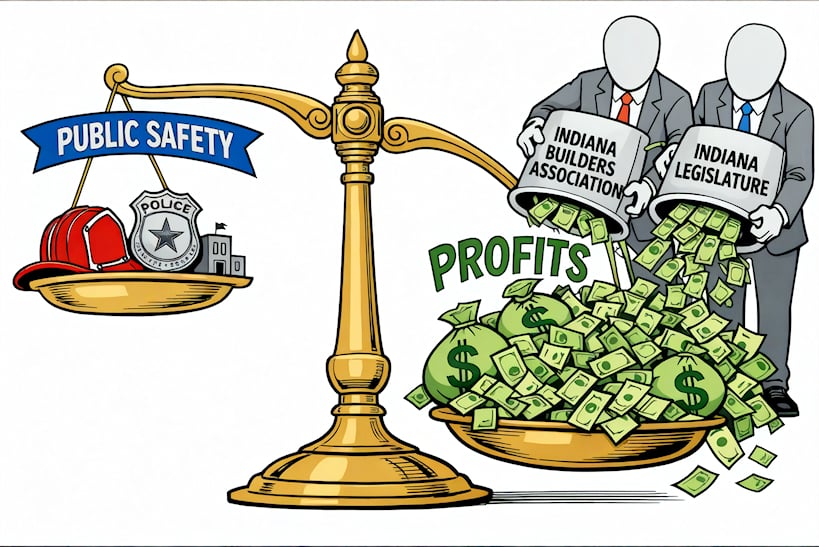
House Bill 1001 was authored by Rep. Doug Miller (R-Elkhart), who serves as a life director of the Indiana Builders Association and board member of the National Association of Home Builders. The bill’s ERCES and AFCI provisions were not in the original legislation. They were inserted as a Senate floor amendment by Senator Chris Garten (R-District 45), Senate Majority Floor Leader, after public testimony had already closed. Senator Garten has served as a board member of the Indiana Builders Association and the Building & Development Association of Southern Indiana, and owns a construction industry business. No public hearing was held on these provisions.
House Bill 1003 was authored in part by Rep. Miller and sponsored in the Senate by Senator Garten, among others. As noted above, the Commission was among more than 60 state bodies abolished or restructured by this legislation — and the only one for which a formal effort was made to preserve it.
Why This Matters Beyond Indiana
Indiana is not alone. Across the country, building and real estate associations have worked to weaken fire and building safety requirements — blocking sprinkler mandates, limiting inspection authority, and preempting local safety ordinances.
The National Association of State Fire Marshals has formally adopted a position opposing any legislative action that bypasses the national consensus code development process, stating that doing so jeopardizes the life safety of the public, building occupants, and first responders.
NFPA President and CEO Jim Pauley has spoken publicly about the coordinated threat to America’s safety code system, warning that communities are increasingly being left unprotected as the independent technical process that underpins safety standards comes under political pressure.
NFPA has launched two initiatives in response. Their Safety Under Assault series examines how the safety code system is being eroded. The Don’t Chance Safety campaign is building public awareness of what is at stake.
The Safer Buildings Coalition is proud to stand alongside NFPA and the National Association of State Fire Marshals in raising awareness of this national threat. We thank both organizations for their partnership and their leadership. Other supporting organizations are in process and will be announced.
What You Can Do
The fire safety community’s response to what happened in Indiana starts with awareness. We ask you to:
- Download the Fact Sheet. A fact sheet co-signed by NASFM and NFPA — with other agencies and associations actively considering joining — is available at [Fact Sheet Link].
-
- Print it. Bring it to FDIC in Indianapolis.
- Bring it home to your department and your leadership. Know what to look for when legislation targeting codes and public safety appears in your community.
- Know your state. Building associations are active in legislatures across the country. Understand what is happening in your state and who is behind it.
- Educate your leadership. Share this article and the resources below with fire chiefs, code officials, elected officials, and community leaders.
- Engage with NFPA’s initiatives. Visit Safety Under Assault and Don’t Chance Safety to learn more and add your voice.
- Contact us. If you are aware of similar legislation in your state, or if you want to get involved in the Safer Buildings Coalition’s advocacy efforts, we want to hear from you. [Contact Form Link]
The people who depend on first responders to reach them in an emergency deserve buildings that work. That starts with safety codes written by experts — not weakened by the industries that profit from building them.
The Safer Buildings Coalition is a 501(c)(4) nonprofit organization with more than 150 member companies. We advocate for public safety communications, emergency responder communication systems, and school safety. Learn more at saferbuildings.org.
Sources: HEA 1001 Enrolled Act; HEA 1003 Enrolled Act; Indiana General Assembly, 2026 Regular Session.
NFPA's President Jim Pauley spoke with SBC Managing Director John Foley recently on the issue of the Safety Under Assault.
To watch the full interview with Jim Pauley, visit https://sbcfastlink.org/SafetyUnderAssault. For more information about NFPA's Don't Chance Safety campaign and to take action, visit DontChanceSafety.org.
John Foley is Managing Director of the Safer Buildings Coalition and serves on NFPA Technical Committee 1225 for Emergency Services Radio Communication Systems and Facilities.